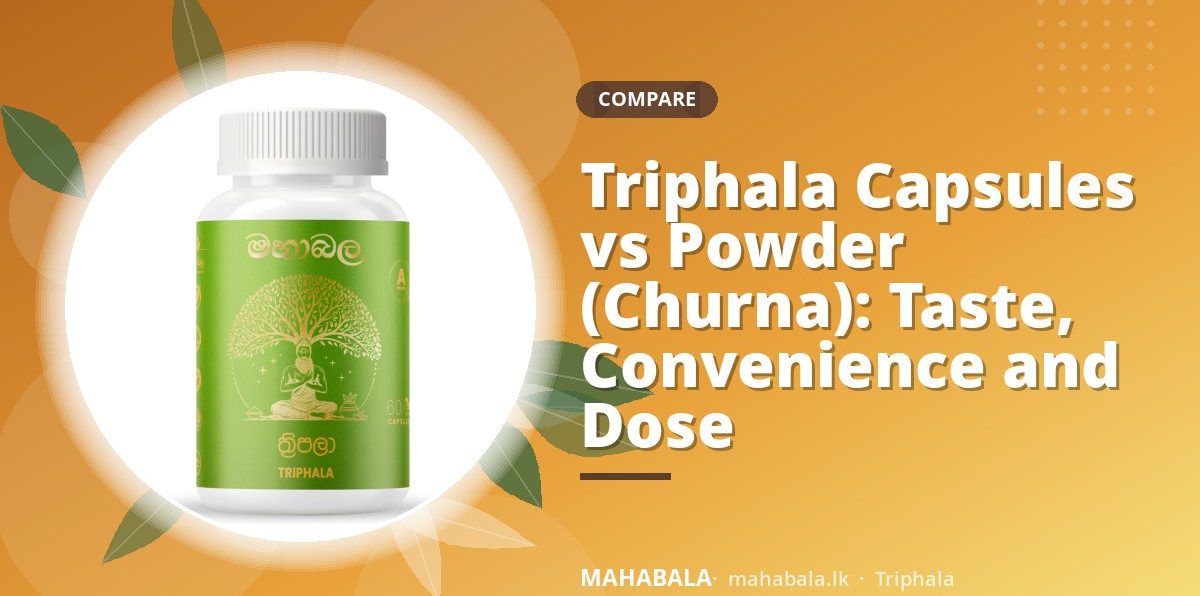
Triphala (ත්රිපලා) is traditionally taken as a powder, or churna. Today capsules are a popular alternative. Here’s how they compare.
Triphala churna (powder)
How: about half a teaspoon to a teaspoon of powder mixed into warm water, or with honey or ghee, as traditionally recommended.
Pros
- The most traditional form
- Easy to adjust the amount
- Some people enjoy the ritual of preparing it
Cons
- The taste: strongly astringent, sour and bitter, which many people find hard to enjoy
- The amount can vary from spoon to spoon
- Messy to carry and easily affected by moisture
Triphala capsules
How: pre-measured capsules taken with warm water.
Pros
- No taste: you don’t taste the astringent powder at all
- Measured: 500 mg per Mahabala capsule
- Convenient and portable: ideal for travel and busy routines
- Stays fresh in a closed bottle
Cons
- Slightly more expensive than loose powder
- Some traditional teachers believe tasting the herb is part of the experience
Side by side
| Churna (powder) | Capsules | |
|---|---|---|
| Taste | Strong, astringent | None |
| Dose accuracy | Varies | 500 mg per capsule |
| Portability | Low | High |
| Preparation | Mix with water | Swallow with water |
| Traditional form | Yes | Modern |
The taste question
Ayurveda believes the taste of a herb matters, and Triphala is said to contain five of the six tastes. If you’re curious, read Triphala and the six tastes. If the taste puts you off, capsules are a simple way to keep Triphala in your routine.
How to take the capsules
1–2 capsules with warm water once daily, at bedtime or in the morning on an empty stomach. See how to take Triphala capsules.
More in the complete guide to Triphala.
Shop Mahabala Triphala capsules
More from our Triphala guide
- Triphala (ත්රිපලා): The Complete Guide to Ayurveda’s Three-Fruit Blend
- A Simple Ayurvedic Daily Routine (Dinacharya) With Triphala
- Triphala and the Six Tastes: Why Ayurveda Cares About Flavour
- Triphala Safety Guide: Who Should Avoid It and How to Start
This article is for general information about traditional herbs and is not medical advice. Speak to a doctor or pharmacist before using herbal products if you are pregnant, breastfeeding, taking medicine or have a medical condition.